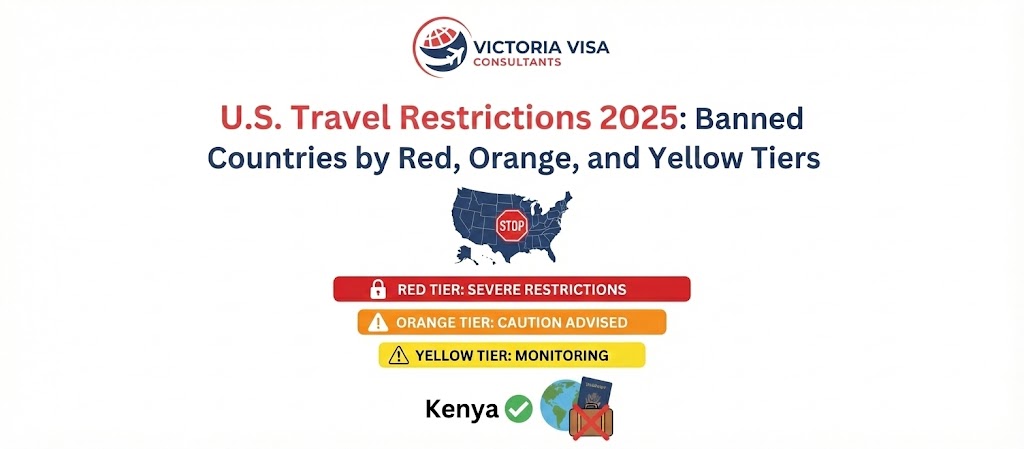
U.S. Travel Restrictions 2025: Banned Countries by Red, Orange, and Yellow Tiers
Is your country on the ban list? Here is a complete Red, Orange, and Yellow country ban list category and what they mean
By Joel Wachira | Dec. 13, 2025, 11:52 p.m.
On June 4, 2025, the United States administration announced sweeping new travel restrictions affecting nationals from multiple countries worldwide. These measures, which took effect on June 9, 2025, at 12:01 a.m. Eastern Daylight Time, represent one of the most significant changes in U.S. immigration policy in recent years.
Whether you're planning to visit family, pursue educational opportunities, or conduct business in the United States, understanding these restrictions is crucial for your travel plans. This comprehensive guide explains who is affected, what exemptions exist, and how Victoria Visa Consultancy can help you manage these complex new regulations to protect your American dream.
Who Is Affected by These Restrictions?
The new proclamation affects nationals from 44 countries, categorized according to the level of restrictions imposed. Twelve countries (red list) face a complete ban on both immigrant and nonimmigrant travel, ten countries (orange list) have significant restrictions on certain visa types, and twenty-two countries (yellow list) are under a 60-day probationary period with closer scrutiny of visa applications.
These restrictions apply only to individuals who were outside the United States on June 9, 2025, at 12:01 a.m. Eastern Daylight Time, do not hold a valid visa as of that time, and are nationals of one of the listed countries. Anyone who does not meet all three criteria is not affected by this proclamation. If you were already in the United States or held a valid visa when the proclamation took effect, you are generally not subject to these new restrictions.
● Red List: Countries with Full Travel Suspension
These countries were proposed for a full suspension of both immigrant and non-immigrant visas in the draft memo. The following table shows the 12 countries totally banned from entering the US.
| Afghanistan | Libya | Syria |
| Bhutan | North Korea | Venezuela |
| Cuba | Somalia | Yemen |
| Iran | Sudan |
● Orange List: Countries with Sharply Restricted Visas
These countries were proposed for partial suspensions affecting non-immigrant visas (like tourist and student visas) and all immigrant visas. The following table shows the 10 countries that are partially suspended from entering the US.
| Belarus | Myanmar | South Sudan |
| Eritrea | Pakistan | Turkmenistan |
| Haiti | Russia | |
| Laos | Sierra Leone |
● Yellow List: Countries with 60-Day to Address Concerns
These countries were given a 60-day probationary period to address security deficiencies or risk being moved to the Orange or Red list. The table below has 22 countries that have been put on a two-month probation period to address identified concerns.
| Angola | Cape Verde | Gambia | St. Lucia |
| Antigua and Barbuda | Chad | Liberia | São Tomé and Príncipe |
| Benin | Republic of Congo | Malawi | Vanuatu |
| Burkina Faso | Congo (DRC) | Mali | Zimbabwe |
| Cambodia | Dominica | Mauritania | |
| Cameroon | Equatorial Guinea | St. Kitts and Nevis |
Why were these countries banned?
The U.S. government evaluated countries based on several specific security and administrative criteria. The administration maintains that these measures are necessary to protect American citizens and maintain the integrity of the immigration system. The following are the risk factors cited by the administration:
● High Visa Overstay Rates
Countries where significant percentages of visa holders remain in the United States beyond their authorized period were flagged as higher risk. The administration views overstays as undermining the legal immigration system.
● Deficient Identity Documentation
Nations with inadequate passport issuance systems, weak identity verification processes, or unreliable national databases were deemed unable to properly document their citizens' identities, making it difficult to conduct proper background checks.
● Poor Deportation Cooperation
Countries that refuse to accept the return of their nationals who have been ordered removed from the United States, or that create bureaucratic obstacles to deportation, were penalized under this criterion.
● Security Threats and State Instability
Countries experiencing civil conflict, lacking effective government control over their territory, or hosting active terrorist organizations were classified as presenting unacceptable security risks.
● Inadequate Information Sharing
Nations that fail to share criminal, security, or terrorist watchlist information with U.S. authorities were determined to prevent proper vetting of visa applicants.
Why Is the Ban Controversial?
The proclamation has sparked significant debate and criticism from multiple quarters. Here are the legal and humanitarian concerns raised by:
● Legal Challenges
Civil rights organizations have filed lawsuits arguing the restrictions constitute discrimination based on nationality and violate constitutional protections. Previous court battles over similar measures suggest protracted legal fights ahead.
● Refugee and Asylum Concerns
The UNHCR and refugee advocacy groups warn that the restrictions may prevent legitimate asylum seekers from reaching safety, potentially violating the principle of non-refoulement under international law.
● Discrimination Allegations
Critics point out that the affected countries are predominantly in Africa, Asia, and the Middle East, arguing the policy has discriminatory intent regardless of stated security rationales.
● Foreign Relations Impact
Diplomatic relationships with affected countries have been strained. Some nations view the measures as insulting and have threatened economic or diplomatic retaliation.
● Removal Procedure
The administration has indicated that countries can be removed from the lists if they make "material improvements" in the identified deficiency areas. However, critics note the criteria for such improvements is vague, and the process for review is unclear.
Who Is Exempt from the Ban?
While these restrictions are extensive, several important exemptions exist that may allow affected individuals to still travel to the United States:
● Automatic Exemptions
- -Lawful Permanent Residents (Green Card Holders) – The ban does not apply to LPRs regardless of nationality
- -Dual Nationals who also hold U.S. citizenship.
- -Diplomatic Visa Holders (A-1, A-2, C-2, C-3, G-1, G-2, G-3, G-4, NATO-1 through NATO-6)
- -International Organization Representatives and their families with proper accreditation.
● Special Categories
- -Athletes and participants in major international sporting events are officially recognized by the International Olympic Committee or major international sports federations.
- -Certain family-based immigrant visa applicants who meet specific relationship criteria
- -Afghan Special Immigrant Visa (SIV) holders and their qualifying family members
- -Humanitarian cases as determined by the State Department on a case-by-case basis
● Important Note on Visa Validity
Even for visa categories not explicitly banned, consular officers retain the authority to issue nonimmigrant visas with reduced validity periods within the limits established by law and regulation. This means approved visas may have shorter expiration dates than they would have received before the proclamation.
How Will This Impact Visa Applicants and Travelers
The restrictions have created immediate and far-reaching consequences for thousands of people with U.S. travel plans:
● Educational Disruption
Students from affected countries who planned to begin or continue their studies in the United States have seen their dreams put on hold. Universities report significant enrollment challenges, and many international students are exploring alternative destinations like Canada, the United Kingdom, or Australia.
● Family Separation
Families who have waited years for immigrant visa processing now face indefinite delays. Weddings, medical visits, and family reunions are postponed or canceled entirely, causing emotional and financial hardship.
● Business and Professional Setbacks
Conferences, business meetings, training programs, and professional opportunities are now inaccessible to many qualified individuals. Companies that rely on international talent face recruitment challenges, while professionals in affected countries lose career advancement opportunities.
● Athletic and Cultural Exchange
While major sporting events have exemptions, smaller competitions, cultural exchanges, and artistic performances face disruption. Participants must go through complex waiver processes with uncertain outcomes.
● Diplomatic Retaliation
Some countries have responded with reciprocal measures. Chad, for example, temporarily refused to issue visas to U.S. citizens in protest. Such responses complicate travel for Americans and escalate diplomatic tensions.
● Humanitarian Concerns
Human rights organizations, the United Nations High Commissioner for Refugees (UNHCR), and international legal experts have raised serious concerns about the restrictions' impact on asylum seekers and refugees. Critics argue the measures may violate international obligations and humanitarian principles.
Is Kenya on the List? What Kenyan Nationals Should Know
Good news for Kenyan travelers! Kenya is not included on any of the three restriction lists (Red, Orange, or Yellow). However, Kenyan nationals and residents should be aware of potential indirect impacts:
While Kenya itself is not restricted, broader regional policy changes could affect mobility patterns, diplomatic relationships, and travel norms in East Africa. If neighboring countries face restrictions or implement reciprocal measures, there could be ripple effects on regional travel.
Changes in U.S. immigration policy may influence academic exchange programs, trade relationships, and diplomatic cooperation that benefit Kenyan professionals, students, and businesses.
Kenyans with family ties to listed countries, or those whose travel involves transit through affected nations, should exercise extra caution and seek professional guidance to avoid complications.
How Victoria Visa Consultancy Can Help You?
At Victoria Visa Consultancy, we understand that these new travel restrictions have created confusion, anxiety, and disruption for countless individuals and families in Kenya. Our mission is to provide clarity, expert guidance, and personalized solutions to help you achieve your U.S. travel goals despite these challenging circumstances.
We don't believe in one-size-fits-all visa advice. Every case receives individual attention, customized strategies, and dedicated support from intake through final approval. Also, we provide honest assessments, realistic timelines, and clear explanations of your options. You'll always know where your case stands and what to expect next.
Our track record speaks for itself. We've successfully helped clients from restricted countries secure visas, reunite families, and achieve their American dreams even under the most challenging circumstances.
So, don't handle these complex visa procedures alone. Let our experienced visa team guide you through the new travel restrictions with confidence and clarity.
Visit our website to book a consultation or contact our office today to schedule your personalized consultation.
Recent Posts
Dec. 22, 2025, 7:34 p.m. - 5 min read
Trump’s $1 Million Gold Card Visa: What Kenyan Applicants Need to Know
Eligibility, costs, and risks Kenyan applicants must understand before applying for Trump’s $1 million Gold Card visa
Dec. 22, 2025, 7:17 p.m. - 6 min read
How to Identify and Avoid Travel Visa Scams: Red Flags, Risks and Safe Application Process
Learn how to identify and travel visa scams, protect your personal information, and ensure a smooth visa application
Dec. 14, 2025, 12:09 a.m. - 5 min read
Expert Guide for Kenyan Workers Applying for Seasonal Jobs in New Zealand
How Kenyan Job Seekers Can Secure Seasonal Jobs in New Zealand
Dec. 13, 2025, 11:52 p.m. - 4 min read
U.S. Travel Restrictions 2025: Banned Countries by Red, Orange, and Yellow Tiers
Is your country on the ban list? Here is a complete Red, Orange, and Yellow country ban list category and what they mean

Dec. 1, 2025, 12:04 p.m. - 5 min read
Post-Study Work Visa Opportunities for International Graduates in 2026
What international graduates need to know about post-study work visa opportunities in 2026
Dec. 1, 2025, 10:50 a.m. - 4 min read
Trump Administration Student Visa Rules: What Kenyan Students Need to Know for 2025-2026
How Trump’s student visa rules affect Kenyan students planning to study in the US